BETA-ProNuclease is a non-specific universal endonuclease derived from Serratia marcescens. It cleaves at any internucleotide linkage, completely digesting nucleic acids into 5′-monophosphate oligonucleotides of 2–5 bases in length. It degrades various forms of DNA and RNA under a very broad range of conditions.
BETA ProNuclease
Enabling a New Approach to Targeted Nucleic Acid Degradation
Comprehensive
GMP Compliance
Working Specs
Complete degradation: Thoroughly removes exogenous DNA, RNA, and nucleic acid residues from viral vectors in biopharmaceuticals and gene therapeutics. Broad-spectrum selectivity for ease of use.
Improved efficiency: Reduces viscosity caused by nucleic acid entanglement, shortens processing time, and improves the efficiency of subsequent purification steps and final product yield. Removal of nucleic acids entangled on the surface of various particles also facilitates the full release and purification of targets within the particles; improves the recovery of soluble inclusion bodies after refolding.
Experimental resolution: Resolution and recovery of ELISA, column chromatography, electrophoresis, and WB can be improved after nuclease treatment.

Animal-origin free: Produced entirely using recombinant protein technology, completely eliminating the risk of contamination by viruses, mycoplasma, and other adventitious agents, providing the highest level of safety for cell therapy, vaccine manufacturing, and biopharmaceutical processes.
Extreme batch-to-batch consistency: Under a strict GMP quality control system, every batch is ensured to have identical enzymatic activity and digestion performance, providing reliable data reproducibility for process validation and large-scale production.
Comprehensive documentation support: Based on the BETAGENE GMP recombinant protein platform system, easily meets stringent domestic and international regulatory audits.
to know more detailes
to read MSDS
to download user manual
| Sequence Source | Serratia Marcescen |
| Appearance | Sterile Filtered Clear Liquid |
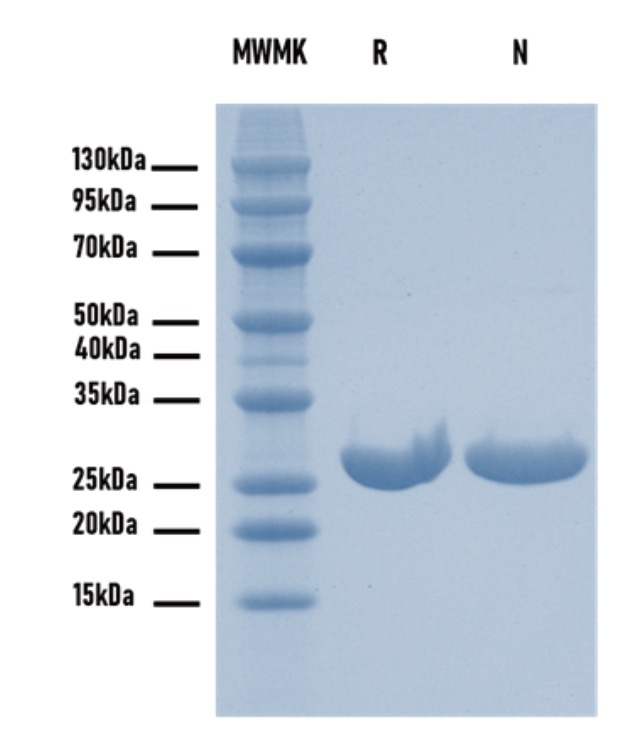
| Molecular Weight | 26.8 kDa |
| Purity (SEC-HPLC/SDS-PAGE) | ≥ 99% |
| Biological Activity * | ≥ 250 kU/mL |
| Endotoxin | < 0.01 EU/kU as determined by TAL method |
| HCP | < 0.5 ng/μg |
| DNA Residue | < 0.02 ng/μg of protein tested by DNA Fluorescent Staining method. |
| Storage | 15-30 ℃, protect from light, or 2-8 ℃ |
ProNuclease Usage Guide
1. Product Description
This product is expressed in E. coli, with a molecular weight of 26.78 kDa, purity ≥ 99% (SDS-PAGE), specific activity ≥ 1.1×10⁶ U/mg, protease activity > 250 U/μL, and endotoxin < 0.01 EU/kU. It is used in scientific research to reduce the viscosity of cell supernatants and cell lysates, improve protein purification efficiency and functional studies, and effectively prevent the clumping of human peripheral blood mononuclear cells (PBMCs) in cell therapy and vaccine research. This product is stored in buffer (20 mM Tris-HCl, pH 8.0, 2 mM MgCl₂, 20 mM NaCl, and 50% glycerol). The product is a sterile, clear, colorless liquid.
2. Addition for Different Applications
Virus purification: Generally added after virus clarification.
Recombinant protein purification from E. coli: Added during cell lysis.
Cell lysate clumping: Can be added directly to the culture medium for co-culture with cells.
3. ProNuclease Dosage
3.1 To reduce viscosity, the amount of ProNuclease added must be determined based on the bacterial concentration of the lysate. If the bacterial concentration is 50%, the recommended ProNuclease dosage is 1/1000–1/200, i.e., 500–2500 kU/L. If the bacterial concentration is 5%, it can be added at a ratio of 1/10000–1/2000.
3.2 For cell lysates, 500 U ProNuclease can be added per 10⁶–10⁷ cells.
3.3 For adenovirus drugs or viral vaccines, adjust the amount of ProNuclease appropriately based on DNA content.
4. ProNuclease Addition Procedure
4.1 For viscosity reduction purposes, if sterile operation is not required, it can be added directly with slow stirring at room temperature for 30 min.
4.2 For applications requiring sterility, it is recommended to dilute ProNuclease with 20 mM Tris (pH 8.0), 20 mM NaCl, 2 mM MgCl₂ buffer, then sterilize by filtration through a 0.2 μm membrane before addition. Incubate at room temperature for 30 min.
5. ProNuclease Removal
ProNuclease is also a protein. If added to bacterial or cell lysates, it will be removed along with other contaminating proteins during purification steps. If added to viruses or viral vaccines, due to the large molecular weight difference between ProNuclease and the virus, it can be removed by gel filtration, such as Sepharose 6 FF. Residual ProNuclease can be detected using commercially available kits. Residual ProNuclease can be detected using commercial kits.
6. Precautions
6.1 The optimal conditions for ProNuclease are pH 8.0–9.2, 37°C, 30 min. The enzyme remains active outside this range, but the reaction time should be appropriately extended or the amount of enzyme added should be increased.
6.2 Magnesium ions are essential for nuclease activity; the recommended concentration is 2 mM. If the sample contains metal chelators such as EDTA, they must be removed, or excess magnesium ions must be added to neutralize the EDTA.
6.3 ProNuclease activity is relatively stable; short-term storage at room temperature will not have much impact. For long-term storage, it must be placed in a -20°C freezer. Since the protective solution contains 50% glycerol, the enzyme solution will not freeze. Once diluted, use it as soon as possible to avoid repeated freeze-thaw cycles.
6.4 If the solution is high-salt, acidic or alkaline, or contains high concentrations of detergents or denaturants, the amount of ProNuclease or the reaction time should be appropriately increased.
Quality and Assurance
Quality is the cornerstone of our sustainable growth and the reason customers continue to choose our products. We place exceptional importance on quality control and assurance, treating product quality as the prerequisite for all our work and approaching our daily work with the attitude that true quality is revealed in the smallest details.
Even the smallest detail can affect product quality and user experience. That is why we have adopted “Every Detail Matters” as our firm quality policy, and we insist on advanced processes and rigorous standards to ensure product quality, continuously improve our quality system, and meet customer needs and tasks efficiently and with high quality.


 Shanghai Public Security Network Security No. 31011502018849